Bamboo Fly Rod Building
- Building
- Home
- Make Yourself a bamboo fly rod
- How to
- Choosing the Bamboo
- Preliminary Planing
- Heat Treating
- The Final Planing
- Hollowing
- Gluing
- Joining the Sections
- The Grip
- The Guides
- Guide Mounting
- Varnishing
- Fly Rod Action
- Partners
- Free
- French
 Canne refendu
FLY ROD ACTION
ACTION AND TAPERS FOR BAMBOO RODS
EXCERPTS CHAPTER XII
Here we are! In all the literature and the advertisement devoted to the object of our passion, we can say indubitably that the discussion of the subject of the rod’s “action” is obviously the weakest, and reveals the least of what it claims to describe. (...)
"The hoax of the action speech"
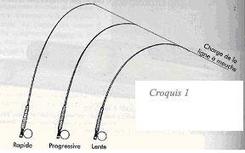
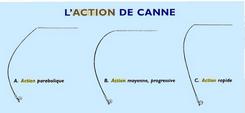
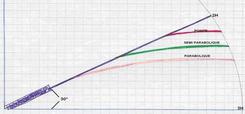
Firstly let us eliminate the advertising statement, and especially the baloney of the a so called "scientific" definition of rod action. It is generally supported with the help of sketches which are supposed to represent graphically the type of "action", using terms like "from the tip", "medium", "slow" or "parabolic". (...)
Action "fast", "slow", "medium", "parabolic", and other inappropriate terms
If you have a discussion with one of those "specialists", those trustees of the truth who launch brands and fashions, about fly rods, you will soon notice two things: the first is that all their talk is aimed at making you replace your equipment. (...)
According to them there exist four sorts of action: "from the tip, medium, slow and parabolic", the order of these terms seeming to indicate a kind of hierarchy. One notes at first that the terms belong to different lexical and determinative fields: "medium" and "slow" are qualifying adjectives whereas "from the tip" and "parabolic" are closer to a definition, the last term being a mathematical one. Do they, however, correspond to a reality?
So, are these sketches inaccurate? Not entirely as they correspond to a feeling one gets when using the rods. Actually they are metaphors for, and symbolic representations of this feeling. The fact that they are used in books or papers speaking learnedly about " rod actions" strikes me as an abuse. (...)
And so, what is the definition of a "fast" rod ? It is one that must be cast with a fast stroke in order to release a length of line, or one which allows you to release the planned length of line as fast as possible? What is the definition of a "powerful" rod? Is it one that is designed for a heavy line, or one that throws a lot of line for each casting stroke? Regarding the "medium" action, what is certain is that when ones head is in an oven and the feet inside a freezer, one could be considered to be at "medium" temperature.
(...)
So, rather than playing the guru and dictating dogma let us simply try to determine that which is possible.
 |
 |
 |
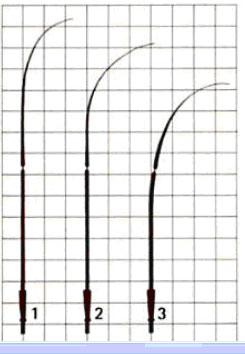 |
| 12.1 | 12.2 | 12.3 | 12.1 to 12.4 Sketch samples found on the web and supposed to represent the action of the rods. |
Calculations and computers
So, what's the design problem? .
Translated into mathematical terms this means to cast a mass, y, with a line length z; to a distance x. From this data and the allowable bending stress (roughly speaking: elasticity) of the bamboo, its density and the desired stress curve shape applicable to the rod in various places along its length, it is possible to calculate a taper.
That is to say, the external section dimensions as measured between opposite flat faces every five or ten centimetres in the metric system or every 5 inches (12.7 cm) in the English system. All these necessary calculations resulted in more developed and complex computer programs (...)
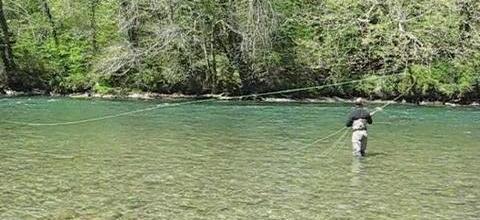
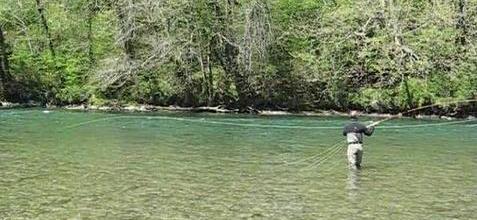
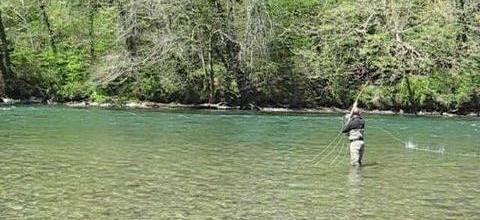
To accurately cast and set down a fly that weighs almost nothing, and which is attached to a thread tied to a line, which has a weight.
  |
|||
  |
Bamboo fly rod building ©2010